Friday, February 27, 2015

Of Simsumara Swaroopa in Vedas !

Simsumar refers to the constellations of Capricornus, Delphinus and Draco


Of Mars

Mars is the son of Earth, according to Indian Mythology, Bhoomi Putra.

Bhoomi Putro Maha Thejo
Jagatam Bhayakrit Sada
Vishti hrit Vishti harta cha
Peedam Harathu me Kuja !


Astronomy of Ancient India

Early Indian Astronomy

The practices of astronomy and astrology in ancient India had their roots almost four thousand years ago. Much of what we know about Indian astronomy comes from the Sanskrit sacred books called the Vedas. These religious texts were a series of hymns composed over several hundred years, and offer intriguing insights into the way Indians of the time viewed the sky. As in most ancient cultures, events in the heavens were believed to have direct effects on people. The practice of astrology, of divining a person's future based on physical phenomena, was a driving force in the advancement of astronomy as a science.
In the Veda texts, the gods were called Devas, which means 'bright' and refers to the luminous nature of the sun and stars. The Sun, comets, the sky, dawn, and the horizon were all deified based on their attributes. To the ancient Indians, the horizon held an immense amount of mystique: it was there that the question 'Will the sun rise again?' was answered every day. A beautiful verse from a Veda mentioning the Indian affinity for dawn says:

'Thou art a blessing when thou art near
Raise up wealth to the worshipper, thou mighty Dawn
Shine for us with thy best rays, thou bright Dawn
Thou daughter of the sky, thou high-born Dawn.'

The earliest Veda text mentioning astronomy is called the Rig Veda, and was written around 2000 B.C. At that time, the earth was considered to be a shell supported by elephants, which represented strength, and were themselves supported by a tortoise, representing infinite slowness.


Indian Astronomy in the First Millenium

As time progressed, Indian astronomy became more scientific and less spiritual. Beginning in the first century, it seems clear that Indian astronomers recognized that the stars are the same as the Sun, only farther away. Verses mention that the night sky is full of suns, and that when our Sun goes below the horizon, a thousand suns take its place. This is an incredible scientific leap in thought. The Earth was at this time considered to be spherical, and various astronomers attempted to measure its circumference. Interestingly enough, the Sun was widely believed to be the center of the universe, an idea which pre-dates western science (with the exception of a few Greek believers) by about 1100 years. However, this idea may be much older: vague references to the sun being in the center of the universe exist in Vedic writings from as early as 3000 B.C.

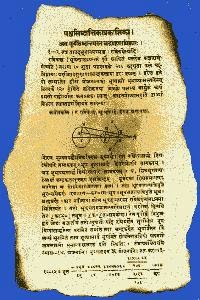
In the 5th century, a great Indian astronomer and mathematician named Aryabhatta advanced this heliocentric theory and also discussed his idea that the Sun is the source of moonlight. He also studied how to forecast eclipses (see photo below). His books and others were translated into Latin in the 13th century, and profoundly influenced European mathematicians and astronomers.

Several Indian scientists of the 6th century also were the first to advance the idea of gravity. They noticed that a special force keeps objects stuck to the earth, and hypothesized that the same force might be responsible for holding heavenly bodies in their place. The idea pre-dates Newton's conception of gravity by about 1100 years.

Tuesday, February 17, 2015

Chyuthi Samskaram

Chyuthi is Orbital Eccentricity. If the motion of the planet is circular, there wont be any eccentricity. As it is elliptical, eccentricty has to be computed. Its values range from 0 to 1 at Ellipse, 0 at Circle and 1 at Parabola ! Chyuthi Samskaram
 in Indian Astronomy means to compute the eccentricity of the planet and reduce the Mean Longitude of the Planet to its Heliocentric Longitude ( Vikshepa Vritteeya Manda Sphuta ).

Monday, February 16, 2015

Happy Siva Ratri !


Happy Siva Ratri !

The Night of Siva occurs when the Moon is in between 156 and 168 degrees from the Sun ( Chaturdasi) in the lunar month of Maagha, in the Waning Moon Fortnight ( Krishna Paksha ).

This is a very sacred day for the Eternians. 
  
Esoteric, scientifc aspects of this Grand Night, vIdeos and photos of the famous Aluva Siva Ratri at http://www.guruvayur4u.com/html/sivaratri.htm

Thursday, February 12, 2015

Wednesday, February 11, 2015

The FIducial Star !

The Fiducial Star of Hindu Astronomy. It is line with the Galactic Center, the Vishnu Nabhi.
It lies in Sagittarius. To the Eternians, Sagittarius or Dhanus month is very sacred because at Sunrise, when one prays facing the East and the Rising Sun, they are praying facing Vaikuntam or Heaven !

Tuesday, February 10, 2015

How Old is the Vedic Civilization?


Using Astronomy and Maths, we have computed the Age of the Vedic Civilization at 5567 years

Read at http://www.eastrovedica.com/html/vedicage.htm

The Fiducial Star, Moola


Lambda Scorpi was called Moola by the Indian astronomers. Moola stands for Moola Adhaar, the Base, the Root. The Rishies meant that this Star is the Base of the Zodiac, its Root !
There are reasons for this
Moola is in line with the Galactic Center, Sagittarius A*.
At that time, Moola was the First Star and Jyeshta was the last.
The Arabs called it Shaula, the Scorpion's Tail.
We feel that ISRO should provide more photos of the 27 constellations of the Indian Zodiac.

Sunday, February 01, 2015

Tharavad Ayurvedic Resort !

We went to an Ayurvedic Resort near Bharata Puzha, for my sister-in-law. I found the Retreat to be marvellous. There is special treatment for Parkinson's disease,Osteoporosis, Arthritis etc.


Monday, January 19, 2015

First Tuesday in Capricorn, Makara Chova

Today is the First Tuesday in the sidereal month of Capricorn, celebrated in all Devi Temples as Makara Chova.

Sunday, January 18, 2015

International Yoga Day !


Q & As about International Yoga Day

Q - Why is June 21 declared as IYD ?
A - Because it is the Day of Summer Solstice, Sayana Karkyadi.

Q - What is the significance of that day ?
a -  On that day, the gross RA of the Sun touches 90 degrees and the
Sun initiates the Southern Solstice, Sayana Dakshinayana.


Saturday, January 17, 2015

Our Mobile Sites.

The Mobile Web population in India has gone upto 173 million. Total Net population is 302 million.

We created mobile versions of main sites. We have uploaded a lot of articles in these sites.

Articles about the Fourth largest pilgrim center in the world and others.
www.m.guruvayur4u.com

Artiicles about Financial Astrology
www.m.stockmarketastrology.com

Articles about the 18 sciences of Indian Philosophy
www.eastro.mobi

Offers from the Kerala Real Estate /
www.m.realtyspeculation.com


Happy reading !


Wednesday, November 12, 2014

Tag Manager

Monday, October 20, 2014

Tomorrow is Dhana Trayodashi

Tomorrow is Dhana Trayodashi, the 13th Lunation, two days before Deepa Vali. Dhana Lakshmi, one of the Forms of the Eightfold Prosperity, Ashta Lakshmi,  is propitiated and precious metals are bought on this day !


Saturday, October 18, 2014

Happy Thula Vishu and Thula Varsha !


The Sun entered  Zero Degree Sidereal Libra yesterday at 0602 PM, initiating Thula Vishu, as well as Thula Varsha.  Vishu or Equinox occus twice on Apr 14 ( Solar ingress into Aries ) and on Oct 17 ( Solar ingress into Libra ).Today is Thula 1,  Aslesha upto  25 Nadis and 48 Vinadis and the Tenth Lunation, Dasami.

The indications to Thula Varsha had  already begun and it rained heavily day before yesterday. Thula Varsha is the North East Monsoon. As the point in the 


Indian Ocean becomes hot, near the Tropic of Capricorn, cool winds come from the Bay of Bengal. pick up moisture and pour over India peninsular. 

We expect more rains in Thula.  Vrischika end ( Dec 15 ) will see the end of the Monsoon Season in Kerala. On Dhanu 10th ( Dec 25 ) , farmers will start irrigating their fields, which they were not doing from May 29 onwards.

The North East Monsoon, Thula Varsha, comes as rains in the afternoon normally, with fireworks ( lightning and thunder ). People are warned not to stay outdoors, not to stand behind solitary trees and not to touch window bars. Thunder and lightning had wreaked havoc in some places in Kerala yesterday !

How accurate the Kerala Calendar is was proved true  as heavy rains and thunder hammered Guruvayur at 0420 PM yesterday. I disconnected the modem and pulled out of office at 0430 PM. Day before yesterday also I pulled out at 0645 PM, when thunder and rains took over. Thunder can damage hard disks.

The Indian mathematicians have not erred and as scheduled  Thula Varsha begam in earnest and it is raining cats and dogs in Guruvayur now. 

Fierce rains slashed Guruvayur at 0420 PM onwards and it is raining torrentially.

The Heavens prove Hindu Calendar true !


The Megha Visphotana or Cloud Explosion at Guruvayur on the evening of Thula Vishu or Thula Varsha day ! ( 0420 to 0510 PM ).

Did the Lord send the shower to prove the Hindu Calendar true ?


Tuesday, October 14, 2014

Q & As about the similarities in the horoscopes of Modi ji & Shivaji.


Q - What are the similarities in these horoscopes ?

A - In both horoscopes, Jupiter is angular. An angular Jupiter can destroy 100 K afflictions, Laksham Doshan Hanti Devendra Poojya. In both horoscopes, Jupiter is in Aquarius. Jupiter in Aquarius gives the effect of exalted Jupiter in Cancer. 

Q - Is Jupiter the King Maker?

A - Yes. He is the largest planet in the solar system. 1300 earths can be fit into Jupiter.He played a vital role in the horoscopes of British Sovereigns. He was angular, either rising ( in First )  or culminating ( in Tenth ).  

In Shivaji's horoscope, he is in the Seventh and in Modi ji's, 4th. Shivaji had Saturn and Venus exalted. Modi ji has Mercury exalted with Jupiter, equivalent to exaltation,  Kumbhe Karkatakal Phalani. 

Mars, in both horoscopes, is well posited. In Modi ji's he is in the Ascendant, conferring Ruchaka Yoga and in Shivaji's, he is in the benevolent 11th. 

More info at 
http://www.eastrovedica.com/html/modi.htm

Wednesday, October 08, 2014

Q & As about Farm Tourism.


Q - What is Farm Tourism?

In Kerala, which is an agri state, Farm Tourism is promoted as a new tourism product. Without much investment, F T can be marketed, as Kerala has 30 lakh hectares of gross cropped area. More than 33% contain plantations of Tea, Coffee, Rubber, Cardamom et al and more than 33% contain coconut plantation. The State has 350 K lakh hectares under paddy cultivation.

5% of the total land has been allocated for  F T..There are schemes which are under way to prepare the plantations/ Farms to receive tourists by presenting a positive image of the Farm and Agri as a whole. The Agri Sector is therefore revitalised and  will increase tourist arrivals in the State.  

Farm Tourism is an integral part of Eco Tourism but there is a slight difference. While artificially created landscapes are part of Eco Tourism - gardens, pond etc - the goal of Farm Tourism is to show the curious tourist about Nature in her pristine purity. .

More info about Farm Tourism at 
http://www.keralaheritages.com/html/farmtourism.htm

Sunday, October 05, 2014

The Seven Branches of Poetry

They are

The Iambic
The Pastoral
The Elegiac
The Anagogic
Tragedy
Comedy
Epic